
Aprilaire Air Duct Cleaning in San Leandro: A Homeowner’s Guide
If a duct cleaner arrives at your San Leandro home and never asks whether you have an Aprilaire whole-home humidifier or high-MERV filter cabinet installed, that’s a red flag before they even uncoil a hose. Aprilaire components change how your duct system accumulates debris, where moisture collects, and how cleaning should be sequenced. Most generalist cleaners treat every duct system the same way, and if you’ve invested in Aprilaire air quality equipment, that one-size-fits-all approach works against you. This guide walks through what Aprilaire ownership means for your ductwork, what a proper cleaning looks like, and how to verify the work was actually done right. If you’d rather skip the reading and just talk it through, call (855) 356-5880.
What Makes Aprilaire Systems Different for Duct Cleaning
Here’s the short answer: Aprilaire equipment actively manages the air moving through your ducts, which means it changes the condition of those ducts over time. A standard duct cleaning assumes passive ducts – air goes in, dust settles, you vacuum it out. But Aprilaire components introduce variables that a competent cleaner has to account for before starting.
The most important variable is the bypass humidifier. Aprilaire humidifiers are typically installed on the supply plenum with a bypass duct that routes a portion of heated air around the furnace. When that humidifier runs during San Leandro’s drier stretches, it introduces moisture into the airstream at a single point in the system. That creates a localized humidity zone inside the trunk line, and in our experience, those zones are where biofilm and debris bond to duct walls faster than anywhere else in the system. It’s not that the humidifier itself is the problem – it’s that the way it changes airflow and humidity means a cleaner who doesn’t understand the component can redistribute residue from that zone instead of removing it.
The second variable is the filter media. Aprilaire’s higher-MERV media filters – the models 210, 410, and 510 are common in San Leandro homes – catch far more particulate than a basic fiberglass filter. That’s good for your air, but it also means less debris reaches the duct walls in the first place. If you’re running a high-efficiency Aprilaire filter year-round, your ducts may genuinely need less frequent cleaning than a neighbor running a cheap one-inch filter. We’d rather tell you that than sell you a cleaning you don’t need yet. A competent cleaner should ask about your filter setup before recommending a service interval.
The Cleaning Sequence for Aprilaire-Equipped Homes
Order of operations matters. On a standard system, the sequence is straightforward: attach the vacuum, agitate the ducts, contain the debris. On an Aprilaire-equipped system, skipping steps or doing them out of order means you’ve paid for half a job. Here’s what a correct cleaning looks like, and this is the sequence we follow for every air duct cleaning job in San Leandro where Aprilaire equipment is present.
- Remove and inspect the filter media. The Aprilaire filter gets pulled first, bagged, and set aside. This protects it from dust blowback during the cleaning and lets the technician assess whether the media itself is saturated or close to replacement.
- Isolate the humidifier. The bypass damper on the Aprilaire humidifier is closed, and in many cases the unit is temporarily sealed off so negative pressure from the vacuum doesn’t pull cleaning debris through the water panel.
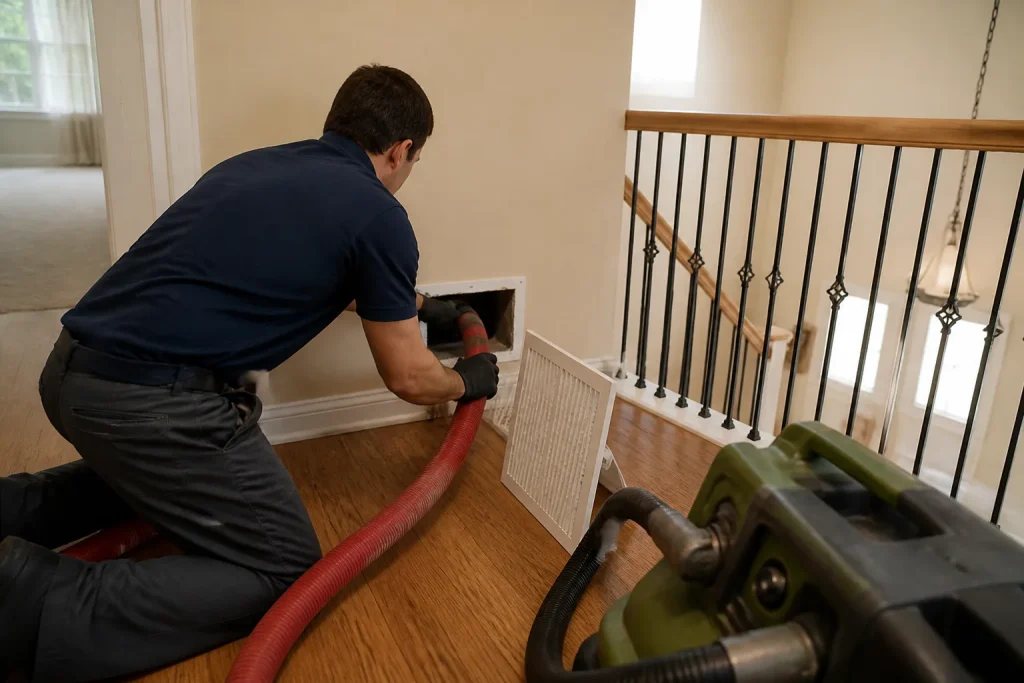
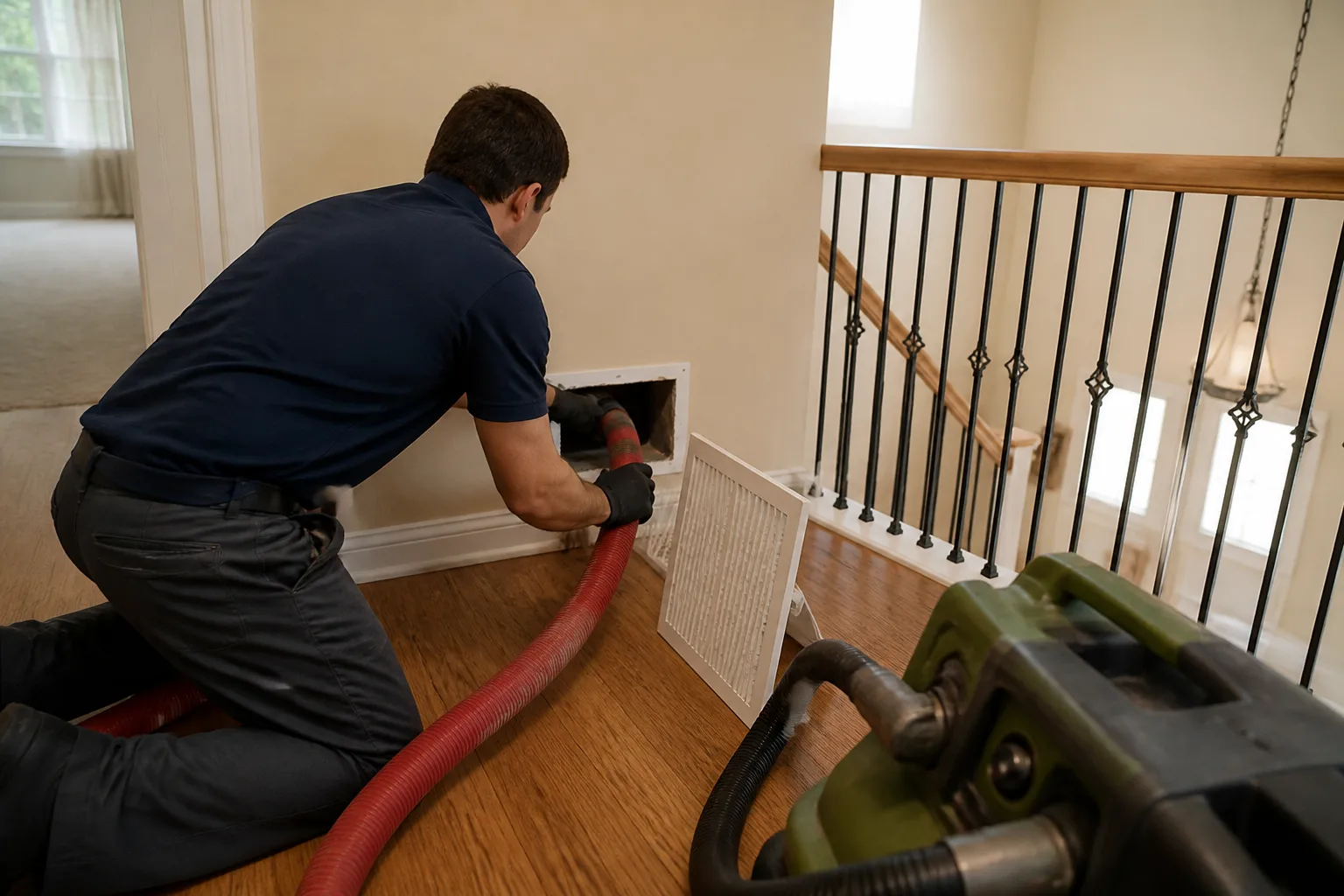
- Establish negative pressure on the duct system. A professional-grade vacuum rig – we use Nikro HEPA units and Rotobrush agitation systems, the same hardware commercial contractors run – is connected at a strategic point so that all loosened debris is pulled outside rather than recirculated into the living space.
- Agitate and extract duct walls. The rotary brush or pneumatic agitation tool works through each branch line and the trunk, dislodging the accumulated film and debris that’s bonded to surfaces – especially the moisture-affected zones near the humidifier bypass.
- Clean the supply and return plenums. These are the collection points where debris concentrates, and they need direct attention, not just a pass-through.
- Reinstall the Aprilaire filter and restore the humidifier. The filter goes back in, the bypass damper is reopened to the correct season setting, and the system is run briefly to confirm airflow is normal.
That last step matters more than most homeowners realize. If a cleaner disconnects something and doesn’t restore it correctly, you may not notice for weeks until humidity levels shift or airflow drops. We’ve walked into San Leandro homes where a previous cleaning left a humidifier damper in the wrong position and the owner spent an entire season wondering why their air felt different.
What Aprilaire’s Own Maintenance Recommendations Cover – and What They Don’t
Aprilaire’s documentation for humidifier maintenance is thorough and worth following. It covers the water panel replacement schedule, cleaning the distribution tray, checking the drain line, and seasonal damper adjustments. What it does not cover is the duct system downstream of the humidifier. Aprilaire assumes the ducts are in reasonable condition and focuses on keeping the humidifier itself functioning correctly.
Here’s the gap: your Aprilaire humidifier can be perfectly maintained while the duct walls downstream of it are accumulating a layer of bonded residue that standard filter replacement never touches. The filter catches particulate before it enters the ducts, but the humidity the system introduces can cause whatever does get through – skin cells, micro-fibers, cooking aerosols that slip past the filter during the months you run a lower-MERV panel – to adhere more aggressively. Aprilaire’s maintenance guide won’t tell you this. It’s not their job to clean your ducts. That’s the gap a full professional cleaning fills.
Think of it this way: Aprilaire maintains the component. A competent duct cleaning maintains the system that component feeds. Both are necessary, but they’re different jobs with different scopes.
How to Verify the Cleaning Was Done Correctly on an Aprilaire System
You shouldn’t have to take anyone’s word that the work was done. Here are the post-service checks you can do yourself in a San Leandro home, and these apply whether we did the job or someone else did.
- Replacement filter is seated correctly. An Aprilaire media cabinet has a specific orientation. The filter should slide in cleanly and the access door should close flush. If it’s forced or crooked, it was reinstalled wrong.
- Humidifier damper is in the correct seasonal position. The bypass damper should be open for winter operation and closed for summer. If you don’t know which is correct for the current season, a quick look at the labeling on the unit or a call to the cleaner should settle it.
- Airflow feels at least as strong as before. Run the system on fan-only mode and hold your hand at a supply register. Reduced airflow after cleaning often means debris got compacted into a branch line or a component wasn’t reseated.
- No new sounds from the air handler. A rattle or whistle after cleaning suggests something shifted during the process. It’s usually a loose access panel or a dislodged duct connection.
- Registers and grilles look clean behind the louvers. The visible surfaces should be free of the fuzzy gray buildup that was there before.
One more thing: ask whether the cleaner used negative pressure throughout the process. If they can’t answer that question clearly, they probably didn’t. Negative pressure is what keeps loosened debris from blowing back into your home. It’s the difference between removing contaminants and rearranging them.
Equipment Matters: What We Run and Why It’s Relevant to Aprilaire Homes
The tools used on your duct system have a direct effect on the outcome, especially when Aprilaire components are involved. Consumer-grade equipment – think a shop vac adapted for duct work – doesn’t generate the static pressure needed to pull bonded residue out of a trunk line. It’ll grab loose dust and leave the rest. That’s a problem in any home, but in an Aprilaire-equipped home where moisture has hardened debris against the duct walls, it’s a guarantee of an incomplete job.
Our crews run Duct Cleaning San Leandro service vehicles equipped with Rotobrush rotary brush systems for mechanical agitation and Nikro HEPA vacuum rigs for extraction. These are the same systems used on commercial duct cleaning contracts, and they’re sized to handle the full length of a residential trunk-and-branch layout without losing pull at the farthest register. For higher-contamination scenarios – post-renovation debris, mold-adjacent situations, heavily soiled systems that haven’t been cleaned in a decade – we have Abatement Technologies air-scrubbing units on hand to capture the fine particulate that standard filtration leaves behind.
That last piece matters for Aprilaire homes specifically. If you’re running a high-MERV Aprilaire filter, the air leaving your system is already cleaner than most. That raises the standard for what a duct cleaning should deliver. Running a HEPA-filtered negative pressure rig during cleaning means the air in your home during the service is being filtered to a comparable standard, not blowing dust around while the work happens.
When to Call a Pro in San Leandro
Duct cleaning is not a DIY job for most homeowners, and that’s doubly true when Aprilaire equipment is in the mix. The risk isn’t just an incomplete job – it’s damaging a component that costs real money to replace. A humidifier bypass misaligned during a DIY cleaning attempt can disrupt airflow balance for the entire HVAC system. A filter cabinet that gets cracked or warped by aggressive handling no longer seals properly, which means unfiltered air bypasses your Aprilaire media entirely.
If your system hasn’t been cleaned in three to five years and you run an Aprilaire humidifier for even part of the year, you’re likely due. The signs are usually visible: dust trails at register louvers, a musty note to the air when the blower kicks on, reduced airflow in rooms farthest from the air handler, or visible debris inside the return grille. In San Leandro’s housing stock – much of it built in the 1950s and 60s with original ductwork retrofitted over the years – disconnected or leaking branch lines are common and contribute to debris infiltration.
Related services in San Leandro: we also handle dryer vent cleaning and duct repair, so if your cleaning uncovers damaged or disconnected sections, the fix can happen on the same visit rather than waiting for a second company to schedule you in.
The Bottom Line
Aprilaire equipment is an investment in your home’s air quality, and it deserves a duct cleaning approach that respects what the equipment actually does. The wrong approach – treating your system like it has no humidifier, ignoring the filter cabinet, and running under-powered equipment – wastes your money and can leave the worst debris right where it was. The right approach accounts for the moisture zones, works the sequence correctly, and leaves you with verifiable results.
If you’re in San Leandro and want a cleaning that’s matched to your Aprilaire system, we’re glad to walk you through the process in person. Call (855) 356-5880 for a free estimate. We answer 24/7. Fast dispatch from 7am to 7pm, Sunday through Friday.
Frequently Asked Questions
With a high-MERV Aprilaire filter like the 210, 410, or 510 running consistently, ducts typically accumulate debris more slowly than homes with basic fiberglass filters. Most San Leandro homes with Aprilaire filtration can go four to six years between cleanings, though humidifier use can shorten that if moisture promotes buildup. The honest answer is that it depends on your home’s specific conditions – pets, renovation history, and how much the humidifier runs all factor in.
It can, if the cleaner doesn’t isolate the unit before starting. A bypass humidifier connected to the duct system can pull cleaning debris into its water panel and distribution tray if negative pressure isn’t managed correctly. The unit should be closed off or temporarily sealed before agitation begins, then restored afterward. A competent cleaner will know this and handle it as standard procedure.
In most cases, yes. Debris accumulation on duct walls effectively narrows the airway, and in older San Leandro homes with decades-old ductwork the restriction can be substantial. A proper cleaning with rotary brush agitation and HEPA vacuum extraction restores the original interior diameter of the ducts, which allows the blower to move air at its designed rate. If airflow doesn’t improve after cleaning, there’s usually a duct defect involved, not a cleaning failure.
Not necessarily. If the filter media still has service life remaining, it can be removed before cleaning and reinstalled afterward. That said, cleaning is a good moment to take a hard look at the media. If it’s visibly loaded or approaching its recommended replacement interval, swapping in a fresh filter at that point maximizes the air quality benefit of the cleaning itself. Call (855) 356-5880 and we can check the filter during your estimate.
Written by the team at Duct Cleaning San Leandro, serving San Leandro since 2018.
Need Air Duct Cleaning Help?
Call Duct Cleaning San Leandro - licensed & insured, here with fast help in San Leandro.
(855) 356-5880